Where Do Kenari Nuts Come From? Inside the Forests of Eastern Indonesia
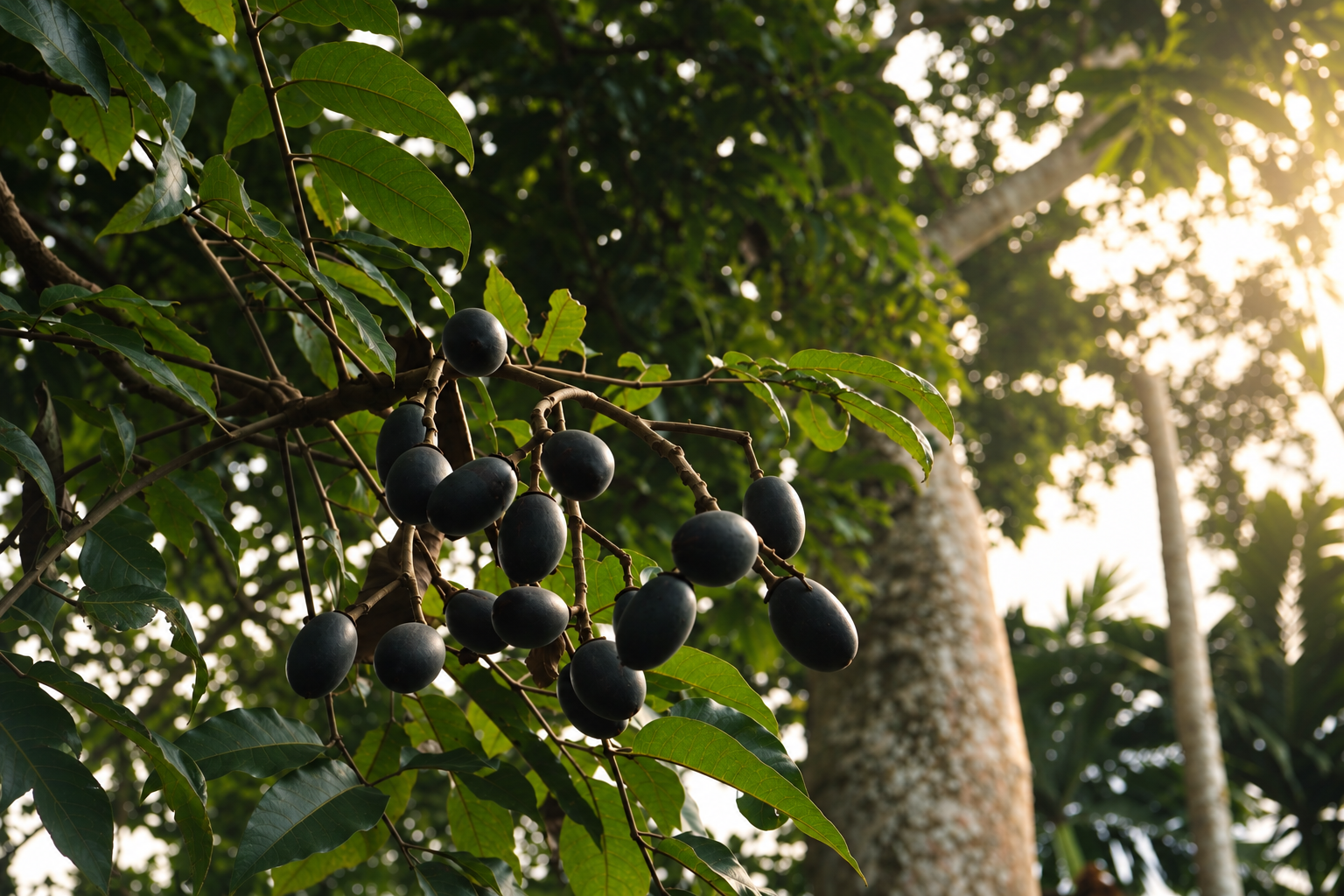
Ripe black Kenari fruits hanging on a Kenari tree in the forests of Eastern Indonesia.
Kenari Nuts come from Eastern Indonesia, where Kenari trees grow naturally across forest landscapes of the region.
Known locally simply as Kenari, the edible nut comes from Canarium indicum L., synonymous with Canarium amboinense Hoch.
For generations, Kenari has been known and consumed by communities in the regions where it grows. The nut is part of a broader relationship between forest, food and people that is different from the story of many commercially cultivated nuts.
Today, Kenari has started to reach consumers beyond its traditional areas of consumption.
But to understand Kenari, it helps to begin where the nut itself begins: in the forests of Eastern Indonesia.
WHERE IN INDONESIA DOES KENARI GROW?
Kenari is native to Eastern Indonesia, particularly the islands and forest of the region.
The region forms part of the Indonesian archipelago historically known as the Spice Islands, an area with a long history of distinctive forest products, food resources and plant diversity.
Kenari trees are naturally present within these landscapes, where they have become part of the local environment and food culture.
Kawanasi's work with Kenari is closely connected to this origin.
Rather than separating the product from the place where it grows, the development of Kenari begins with understanding its forest origin, the people connected to it and the conditions under which the fruit is harvested and handled.
KENARI TREES IN THE FOREST
Kenari is a tree species capable of reaching considerable size.
Mature Kenari trees can grow to around 30–40 metres in height, with some trees being more than 35 years old.
These are not simply agricultural plants grown for a single harvest.
They can become long-lived components of the forest landscape.
This gives Kenari a different identity from a nut that is primarily associated with intensive orchard production.
The edible kernel is only one part of a much larger system:
tree → forest → fruit → people → food
Understanding this relationship is important when considering how Kenari can be developed responsibly for wider markets.
A FOREST FOOD WITH A LONG LOCAL HISTORY
Kenari is not a newly discovered food for the communities where it naturally grows.
Local communities have traditionally harvested and consumed Kenari, with knowledge of the fruit and its handling passed between generations.
Harvesting has historically relied on manual and traditional practices, connecting the production of the nut directly to the people who know the forest and its resources.
For communities familiar with Kenari, the nut is therefore not simply an unfamiliar ingredient.
It is part of the local food landscape.
The international development of Kenari is, in many ways, a process of introducing this existing forest food to people who have never encountered it before.
FROM TREE TO FRUIT
Kenari begins high in the forest canopy as a fruit on the tree.
After harvesting, the fruit passes through several stages before the edible kernel is obtained.
The basic progression is:
Kenari Tree → Kenari Fruit → Kenari In Shell → Kenari In Testa → Kenari Nut
Each stage presents its own handling requirements.
The fruit must be harvested and handled appropriately, and the outer materials must eventually be removed to obtain the edible kernel.
This means that developing Kenari as a food product requires more than simply collecting a nut from the forest.
It requires a post-harvest system capable of maintaining quality from the point of harvest through to the finished kernel.
WHY THE FOREST ORIGIN MATTERS
The origin of Kenari is more than a geographical detail.
It influences the way the nut is sourced, the people involved in harvesting it and the way value can be created around the resource.
For Kawanasi, this makes the forest origin part of the product's identity.
The objective is not simply to take a forest resource and turn it into a packaged food.
It is to develop a value chain that can connect:
→ the forest
→ local communities
→ harvesting
→ post-harvest handling
→ quality
→ processing
→ products
→ international markets
This approach allows the value of Kenari to extend beyond the kernel itself.
KENARI AND LOCAL COMMUNITIES
The relationship between Kenari and local communities is an important part of its story.
Traditional harvesting connects people directly with the trees and forests where Kenari grows.
For communities, developing greater value around Kenari can create opportunities to strengthen the economic value of a resource that has long existed within their landscape.
But developing that value requires more than increasing demand.
It requires attention to responsible sourcing, quality, traceability and the long-term relationship between the resource and the people who depend on it.
This is one reason Kawanasi considers people and forests together when developing Kenari.
The opportunity is not simply to create a new international food product.
It is to create greater value around a distinctive Indonesian forest food while maintaining the connection to its origin.
FROM A LOCAL FOREST FOOD TO AN INTERNATIONAL PRODUCT
For much of its history, Kenari was primarily known in the regions where it naturally grows and is traditionally consumed.
Its international journey began when Kawanasi started presenting Kenari to audiences outside Indonesia.
Since then, Kenari has progressed through organic certification, international market development, regulatory authorization and product development.
The journey has taken Kenari from its forest origin in Eastern Indonesia to international food exhibitions, organic markets and consumers in different parts of the world.
Yet the starting point remains unchanged: Eastern Indonesia.
The international product is connected to the same forest-origin nut that has long been known locally.
WHY KENARI'S ORIGIN IS PART OF ITS IDENTITY
Many food products can be separated from their place of origin.
Kenari is different.
Its identity is closely connected to the forests where the trees naturally occur, the communities that have traditionally harvested the fruit and the knowledge surrounding its use.
That connection gives Kenari a story that extends beyond taste and nutrition.
It is a story about place, biodiversity, food and people.
This is also why developing Kenari internationally creates an opportunity to communicate more than simply what the nut tastes like.
It allows consumers to understand where it comes from and why its origin matters.
FROM THE FOREST TO THE WORLD
Kenari's journey from Eastern Indonesia to international markets is still developing.
Kawanasi works across sourcing, post-harvest handling, quality, product development and market development to build a stronger path between the forest and the consumer.
The goal is to make Kenari more accessible to the world while keeping its origin visible.
Because before Kenari became an international product, it was, and remains, a forest food from Eastern Indonesia.
EXPLORE MORE ABOUT KENARI
What Are Kenari Nuts?
Learn about Kenari's identity, botanical name, characteristics, nutrition and what makes this Indonesian forest nut distinctive.
Read What Are Kenari Nuts? →
#SignifiKenari
Discover the deeper connection between Kenari, forests, communities and the opportunity to create lasting value from this remarkable natural resource.
Explore #SignifiKenari →
Kenari Nuts
Explore Kenari's origin, characteristics, journey from fruit to kernel and development from Eastern Indonesia to the world.
Explore Kenari Nuts →